

About the artwork
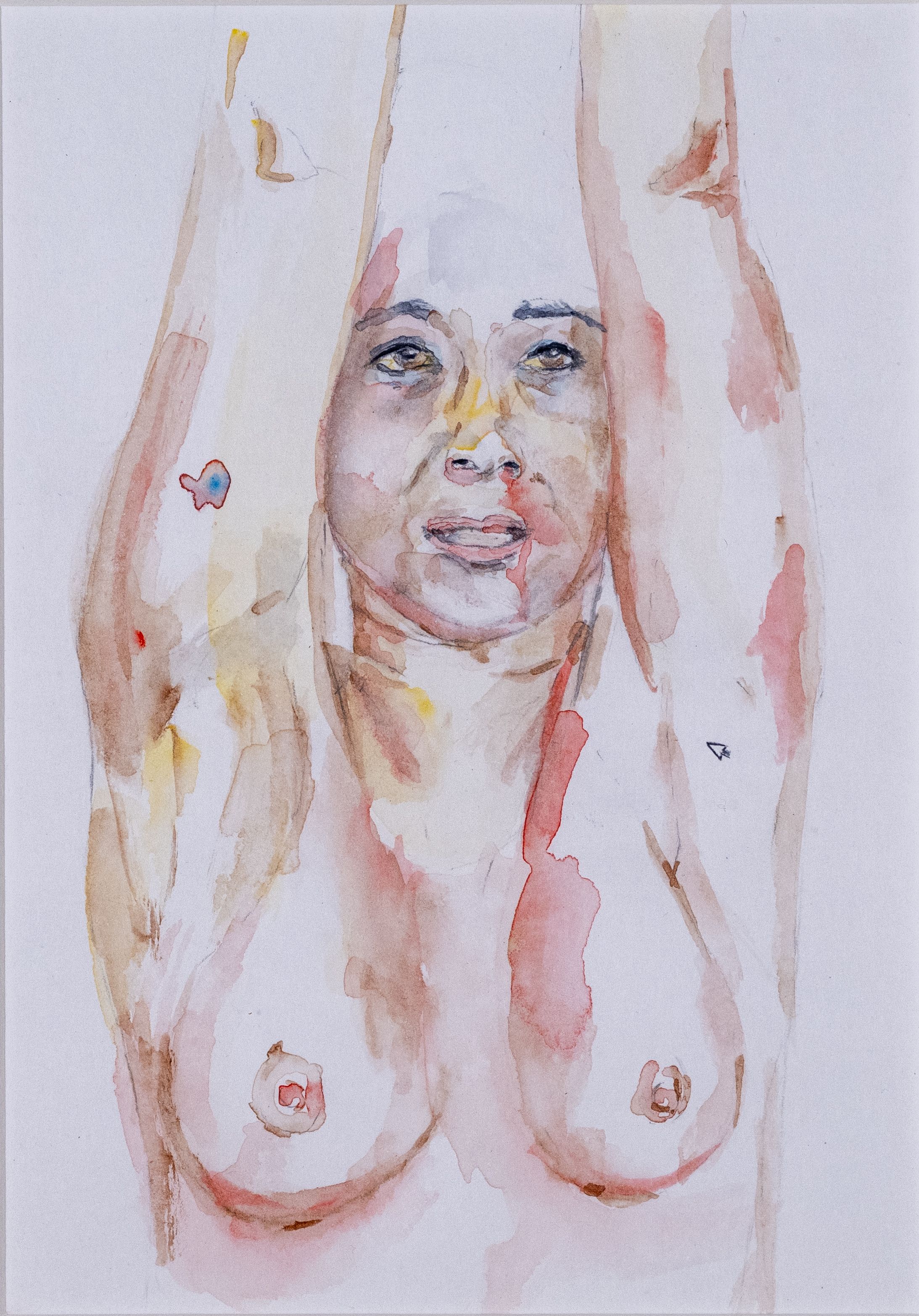
Madonna Complex takes its point of departure from the Madonna-Whore complex, which describes the state where desire and what one wishes for are irreconcilable. By moving in close, the artist creates an intimacy in the motifs that sets this series apart from the preceding one.
The discomfort in Palpitating largely stems from a voyeuristic approach to the body and people in explicit situations and depictions. In Madonna Complex, however, it is the emotional reactions we witness that generate the discomfort of being too close. The faces reveal and expose the portrayed individuals in moments of ecstasy, shame, anger, fear, uncertainty, and disgust.
The materiality of the motifs and the use of watercolor are also significant. In this series, the nature of watercolor becomes a symbolic extension of human nature. It is a medium that requires both precision and control to create a coherent and unified image. By allowing the colored water to flow across the paper, the artist seemingly lets go of some of this control. Despite this "loss of control" on the artist's part, there is no doubt that it demands immense control to create a composition of such detail with such an unwieldy medium. In other words, it is a performance for the gallery.
The use of watercolor as a technique can also be interpreted as a symbol of the overarching theme of the series. The way the colored water moves across the paper while slowly being absorbed into it and becoming part of its material is itself symbolic. It can evoke how desire and shame wash over a person and gradually become a permanent part of their mental and sexual attitudes.

About the artist
Andreas Reutz, born in 1986 and based in Oslo, is a Norwegian artist in painting, design, and 3D art. His work is conceptually driven, often exploring gender, sexuality, and existentialism through figurative and abstract forms.
Reutz’s art is experimental and closely connected to the digital world. It is inspired by the Japanese philosophy of wabi-sabi, which embraces imperfection and transience.
Reutz describes his creative process as an emotional journey, where creativity flows naturally but can be controlled. He believes that true creativity requires a balance between emotional highs and lows, and this tension drives his work forward. His personal experiences of feeling like a chameleon—fitting in without fully belonging—shape his storytelling style. For Reutz, art is about authenticity, and he draws from his own life to create genuine works.
A key moment in Reutz’s life was when he confronted his fear of the dark while alone in the forest. This experience taught him that fear—and creativity—is largely a product of the mind. This insight has shaped his approach to art, where he embraces the unknown and challenges boundaries.
What makes Andreas Reutz interesting as an artist is his ability to blend personal experiences with broader social issues while maintaining a playful ambiguity. His work challenges conventional thinking about gender and identity using traditional and digital media, making him a relevant voice in contemporary art.